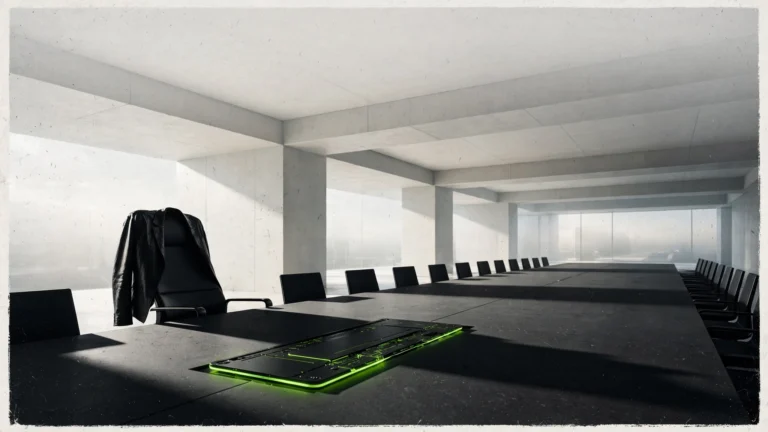

Nvidia’s board reinstated Jensen Huang as chief executive, president and a director on Monday, 11 days after he resigned over extramarital affairs, saying input from senior US government officials had satisfied it that his return poses no national security risk. The unanimous decision, disclosed in a company statement, reversed a position the board’s chairman had taken publicly on last week’s earnings call and lifted the chipmaker’s shares sharply at the open.
A unanimous reversal, 11 days after the resignation
The board “voted unanimously to reinstate Huang following a series of discussions and meetings with him,” South China Morning Post reported, citing the statement, and said it was satisfied with “Mr. Huang’s candour and ability to lead NVIDIA.” The Wall Street Journal reported the move came 11 days after Huang resigned and restored both the CEO role and a board seat. The company said the appointment was effective immediately.
The reversal was abrupt. Harvey C. Jones, named the board’s first-ever chairman on Nov. 12 when Huang stepped down, told analysts on last week’s earnings call that the board “does not intend to reinstate Jensen as CEO,” Forbes reported, even as a public campaign pressed for his return. In Monday’s statement Jones said the board believed Huang was “the right person to lead NVIDIA” and that his return was in the best interests of stockholders, employees, partners and customers.
Colette Kress, chief financial officer and executive vice president since 2013 and interim CEO since Nov. 12, will return to her finance role, according to an account of the announcement that the statement excerpts reviewed did not confirm. Huang thanked Jones and Kress and Nvidia’s executive staff for their leadership during the “brief period of disorder.” Kress, who previously worked at Cisco, Microsoft and Texas Instruments, said Nvidia’s “strength has always come from its people.”
What the board resigned over
Huang resigned effective immediately on Nov. 12 after the New York Times reported he had an affair with a businesswoman US intelligence suspects to be a Chinese spy; Beijing denies the allegation, AP reported. The Journal said the board acted after revelations of at least two extramarital affairs, including one with a woman US officials believed was working with Chinese intelligence and one with a senior direct report. AP said employees described a second relationship with an executive who reported to Huang directly; Forbes named her as Nvidia executive Kimberly Powell.
Huang apologised to staff. “My actions hurt her and our children,” he wrote in a Sunday email to employees, saying he had been “unfaithful to my wife” and that colleagues “deserve better.” He co-founded Nvidia in 1993 with Chris Malachowsky and Curtis Priem and had led it for 33 years — the entire life of the company — until Nov. 12.
The board had no succession plan to fall back on. The Journal’s Morning Risk Report noted that Huang, 63, “doesn’t believe in succession planning,” runs a flat structure with roughly 60 direct reports, and that Nvidia’s proxy statement warns the company is “highly dependent on the services of our longstanding executive team,” with a failure to ensure effective succession planning potentially able to “hinder our strategic planning, execution, and long-term success.” Bloomberg reported Nvidia had tapped an outside firm to identify candidates; AP said the company was considering “internal and external candidates.”
Washington’s role in the boardroom vote
The board attributed its national-security judgment to the US government. “In the process of reaching its decision, the board received input from senior levels of the United States government, and based on that input, the board is confident that Mr. Huang’s reinstatement poses no national security risk,” the statement said, according to SCMP and the Journal. Neither outlet’s account identified the officials, the agencies or the channel through which the input arrived.
President Donald Trump, in a phone interview with CNBC’s Eamon Javers on Monday morning, said Huang “did nothing wrong” and that “I think the [Nvidia] board acted really responsibly.” He added: “They did ask for assurance on the national security threat. And we gave him assurance at least with everything we know, and we know a lot.” Forbes reported Trump had been “speaking to the board directly and indirectly” and had publicly advocated Huang’s return on Sunday night, calling the outcome “correct and proper.”
An account of the same interview went further, quoting Trump as saying “I believe my intervention was very important,” that “the board decided to do what we wanted them to do,” and that “basically, I was represented at the board,” while declining to say whether he had joined the meeting by phone. Those quotes were not in the CNBC excerpt reviewed. The same account said Trump spoke with Huang on Sunday and that Attorney General Todd Blanche confirmed the government “does not possess evidence that he has engaged in any unlawful conduct”; no Justice Department statement appeared in the materials reviewed. Trump and Huang have appeared together publicly, including at a White House briefing on artificial intelligence on Sept. 29.
The market reaction, and a gap in the numbers
Forbes said Nvidia shares jumped in premarket trading and were “nearly 30% up at market open” on Monday. It put Huang’s net worth at $145.5 billion as of 9:45 a.m. EST, a 30% lift from the stock move, after the scandal had pushed him out of the top 10 of its wealth ranking to 18th place.
A separate account circulating Monday put the opening move at 33%, to $165.57 a share. The two descriptions cannot both describe the same prior close: a 33% gain to $165.57 implies a Friday close of about $124.49, while a 30% gain implies about $127.36, a gap of roughly $2.87. The same account cited an all-time high of $239.24 reached last month, against which $165.57 would be 30.8% lower; that high was not confirmed in the sources reviewed. Both figures describe a single session and should not be read as a trend.
Capitol Hill’s calendar outlasts the board vote
Congressional scrutiny did not end with the board’s vote. CNBC reported on Nov. 17 that Huang and his lawyer, identified as Teter, would appear before House panels in December for transcribed interviews, a format typically conducted behind closed doors. An account of Monday’s announcement described the schedule as an interview “next week” with three House committees; CNBC’s reporting points to December.
The Senate is moving separately. Senate Banking Committee Chairman Tim Scott, Republican of South Carolina, summoned Huang to a public hearing on Dec. 3 and threatened a subpoena if he did not appear, CNBC reported. Scott also called on Commerce Secretary Howard Lutnick to testify on Dec. 10.
The focus is Megaspeed. Alice Huang was an executive at the Singapore-based technology company, which Nvidia sold chips to, “raising concerns in Washington that at least some of the chips were subsequently diverted to China,” CNBC reported. Whether the Justice Department has opened a criminal investigation into potential export-control violations at Megaspeed was not disclosed in the sources reviewed.
Questions and answers
When exactly did Huang leave and return? Nvidia announced his resignation effective immediately on Thursday, Nov. 12. The board reinstated him on Monday, Nov. 23 — a gap of 11 days, which matches the Journal’s account. He returned to the same three titles he held before: chief executive, president and a director.
Who ran Nvidia in between? Colette Kress, CFO and executive vice president since 2013, became interim CEO on Nov. 12. AP reported she had previously worked at Cisco, Microsoft and Texas Instruments. An account of Monday’s announcement said she would return to the CFO role; the statement excerpts reviewed did not address the CFO position.
Why did the board change its mind? The statement cited two reasons: a series of discussions and meetings with Huang that left the board satisfied with his “candour and ability to lead,” and input from senior levels of the US government that it said removed national security concerns. Jones had said on the prior earnings call that the board did not intend to reinstate him.
Did Trump speak to Huang before the decision? Trump told CNBC he had been “speaking to the board directly and indirectly,” according to Forbes. An account of the interview said Trump spoke with Huang on Sunday about the reinstatement. Nvidia’s statement, as reported, described only government input and did not mention a presidential call to Huang.
How large was the share move? Forbes put the opening gain at nearly 30%; a separate account said 33% to $165.57. The two imply prior closes of about $127.36 and $124.49 respectively. Forbes valued Huang’s net worth at $145.5 billion at 9:45 a.m. EST Monday, ranking him 18th.
What happens next in Congress? Huang faces a public hearing before Senate Banking on Dec. 3, with a subpoena threat if he declines, and Lutnick is called for Dec. 10. House panels have scheduled transcribed interviews with Huang and his lawyer in December. The committees have not, in the reporting reviewed, published the full scope of their requests.
Is the national security question closed? The board says it is, based on US government input. Beijing denies the spy allegation against Alice Huang, and the status of any Justice Department investigation into Megaspeed was not disclosed in the sources reviewed. Huang’s congressional appearances are scheduled after the reinstatement, not before it.
The board has restored its CEO, but the inquiries that prompted its doubts are still ahead of him, now on a December and Dec. 3 calendar rather than a closed boardroom. Nvidia has not said who provided the government input that underpinned Monday’s vote, and that silence is likely to be the first question Huang faces under oath.