
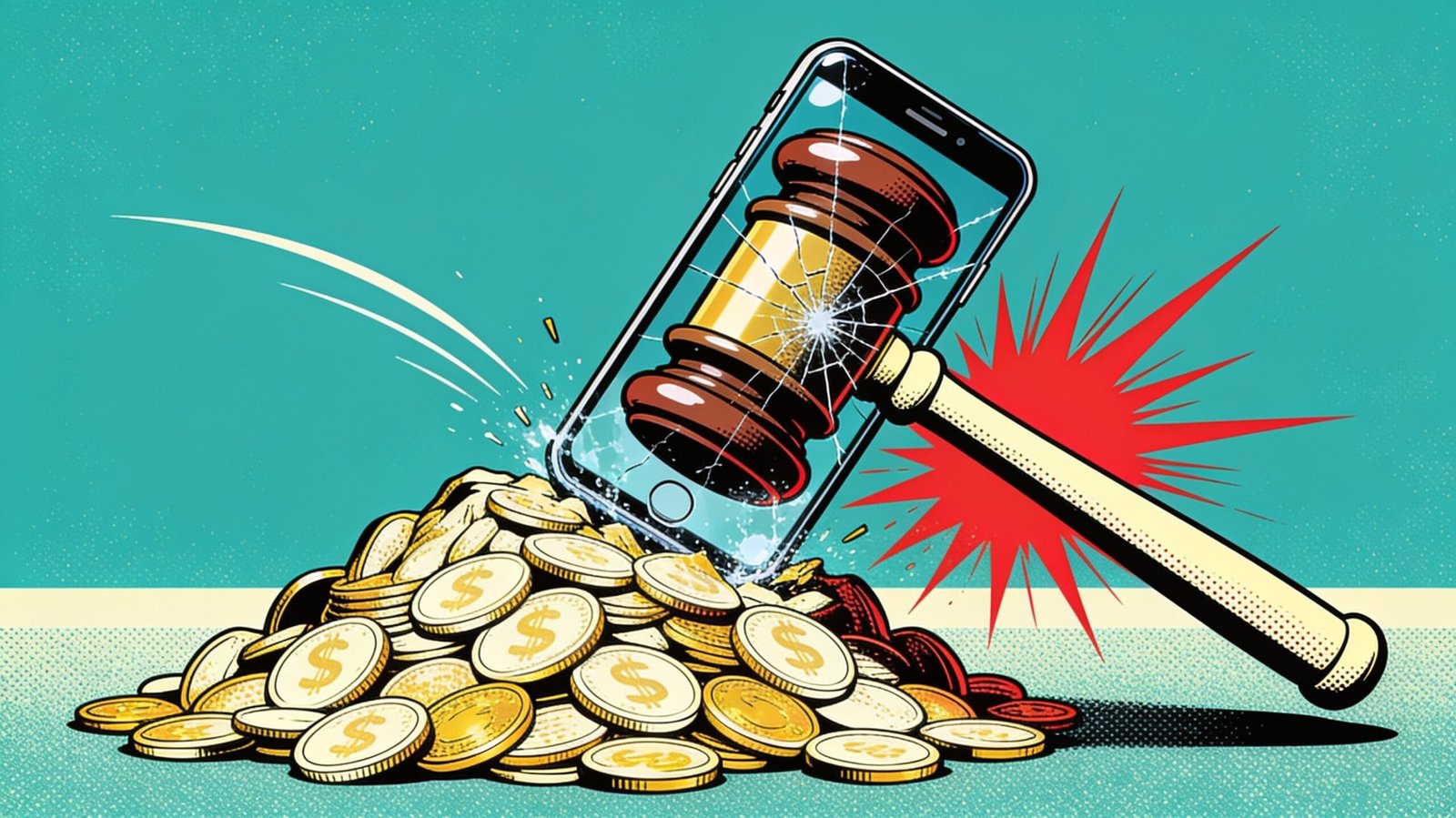
Meta Platforms settled a teen-safety case brought by 29 states on August 26, 2026. The consent judgment was filed in the U.S. District Court for the Northern District of California in Oakland before Judge Yvonne Gonzalez Rogers, ending a trial in its second week. California Attorney General Rob Bonta co-led the case with Colorado, New Jersey and Kentucky; California could receive $1.5 billion to $2.1 billion, and Texas negotiated a separate $1 billion payment. Meta denied wrongdoing; the states had sought roughly $200 billion. Fortune reported the package at up to $17.1 billion, 12 times Meta’s $1.4 billion 2024 benchmark ($17.1B ÷ $1.4B = 12.2×), and the largest state consumer-protection settlement outside the 1990s tobacco deals.
CNBC reported on August 29, 2026 that the settlement landed now because states had carried the case to a jury trial. The payout is one symptom of a wider malaise: OpenAI and Anthropic have amplified job-loss fears while data centers rise in backyards, and consumer confidence sits at a seven-month low. Jim Steyer, chief executive officer of Common Sense Media, told CNBC the techlash ‘is not partisan at all.’ More than 90 cities deactivated, rejected or canceled Flock Safety contracts in 2026, according to DeFlock as cited by CNBC. Meta had spent years contesting design liability rather than capping teen usage. Timing is awkward: the settlement arrives under 10 weeks before the November 2026 midterm elections and ahead of Anthropic’s and OpenAI’s planned listings, suggesting the political cost of AI is being priced by courts and ballots before bankers.
Trust deficit meets the ballot box
Anthropic topped a $65 billion revenue run rate, per CNBC, while OpenAI generated $20 billion in 2025 revenue, according to Forbes. Anthropic confidentially filed for an IPO on June 1, 2026, according to Reuters, after raising $65 billion in a Series H-1 round at a $965 billion valuation in late May 2026. Its prior round was $30 billion in February 2026 at a $380 billion valuation, a step-up of $965B ÷ $380B = 2.5×. OpenAI filed confidentially on June 8, 2026, according to Bloomberg, after a $122 billion round in March 2026 backed by Microsoft, SoftBank and Nvidia at an $852 billion valuation; Microsoft owns 27%. OpenAI chief financial officer Sarah Friar has reportedly questioned data center spending. Meta’s settlement follows TikTok’s $400 million agreement with the Justice Department on August 21, 2026, per CNBC. Anthropic chief executive officer Dario Amodei wrote on X on August 15, 2026: ‘I think it is fundamentally a crisis of trust.’
Conflicting totals, accelerating opposition
Settlement totals conflict across outlets, reported without averaging: court filings specify up to $16.68 billion (Reuters), CNBC reported $16.7 billion, and The New York Times and Fortune reported up to $17.1 billion. Paying-group coverage conflicts: 47 states plus D.C. and U.S. territories (The New York Times), 48 states plus D.C. and three territories (BBC), or 52 attorneys general (CNBC). Fortune called it roughly a 1% tax; against Meta’s $1.47 trillion market capitalization on August 28, 2026, $17.1B ÷ $1,470B = 1.2% of value. Multiples diverge: Anthropic at $965B ÷ $65B = 14.8× run rate versus OpenAI at $852B ÷ $20B = 42.6× 2025 revenue. Structural asymmetry: Meta’s exposure is retrospective design liability; the labs’ is prospective disclosure risk. Opposition costs accelerated: $130B ÷ $156B = 83.3% of all 2025 data center disruption came in Q1 2026, and opposition groups rose from 396 to 833, 833 ÷ 396 = 2.1×.
IPO pipelines meet public sentiment
For investors, the settlement means product design is now a priced legal liability rather than a growth metric. For Anthropic and OpenAI, backlash is a disclosure item, not a sentiment footnote: sources told CNBC that negative sentiment toward AI and data centers will appear as a risk factor in Anthropic’s prospectus, expected within weeks of August 21, 2026, and that investors project a float near $2 trillion, implying $2,000B ÷ $65B = 30.8× the run rate. Anthropic declined to comment. Enterprises choosing between Claude and ChatGPT inherit the same local-permitting and reputational risk. ‘Treating it as a PR problem and a problem of public sentiment would be tremendously misguided,’ Sarah Myers West, co-executive director of the AI Now Institute, told CNBC on August 29, 2026. Amodei conceded the delivery gap, writing that AI companies ‘haven’t yet delivered on our big promises to benefit the world,’ according to TechCrunch.
Execution risk: safeguards must persist for 10 years with annual payments and an independent auditor. Approval status conflicts: Fortune reported on August 28, 2026 that Judge Yvonne Gonzalez Rogers had yet to sign off, while CNBC reported approval on August 26, 2026. Revenue disclosure risk: Anthropic’s $65 billion run rate (CNBC) and $47 billion 2026 annual recurring revenue estimate (Forbes) are different metrics, reported without averaging. Antitrust review status not disclosed. Cross-border regulatory exposure not disclosed. No joint venture involved. Caveats: Jennifer Huddleston of the Cato Institute says many unions back data centers for electrical and HVAC hiring; West warns campaigns alone will fail. Both listings, targeted for the fourth quarter of 2026, are seen as slipping, according to Forbes.
What the record shows
Does Meta admit wrongdoing? No. Court filings record that Meta denied wrongdoing, and the states sued over product design rather than user posts, which Section 230 of the Communications Decency Act largely shields, according to Yahoo Finance. What must Meta change? A default two-hour daily limit for under-18 users on Facebook and Instagram, no push notifications during weekday school hours, stronger age assurance, expanded parental controls and an independent auditor. How distrustful are Americans? More than half are more concerned than excited about AI, up from 37% in 2021, according to Pew Research Center via CNBC, and a CNBC Generation Lab survey of 18- to 34-year-olds found more than 75% do not trust Amodei and around 70% do not trust Altman or Zuckerberg. Who is financing the blocked projects? Reuters reported on August 10, 2026 that banks now weigh community opposition inside credit-risk assessments, and Goldman Sachs forecasts more than $6 trillion in AI spending through 2030. Meta’s payment closes one case, not the sentiment behind it: up to $17.1 billion against continuing suits. The labs carry that sentiment into public markets, where disclosure replaces defense.
Meta Platforms at a Glance
- Company: Meta Platforms, Inc.
- Founded: 2004 by Mark Zuckerberg and others
- HQ: Menlo Park, California, USA
- Category: Big Tech
- Focus Keyword: Meta Platforms settled a
| Round | Date | Amount | Lead | Valuation | Co-Investors |
|---|---|---|---|---|---|
| No traditional venture rounds | N/A | N/A | N/A | N/A | N/A |
Frequently Asked Questions
What does Meta Platforms do?
Meta Platforms operates Facebook, Instagram, Messenger, and WhatsApp, serving billions of users worldwide. It generates revenue primarily through digital advertising and has invested heavily in AI and immersive technologies. Additionally, Meta develops hardware like Quest VR headsets and Ray-Ban Stories glasses. The company faces regulatory scrutiny across jurisdictions, including recent settlements over teen safety and privacy concerns. Its response to such challenges shapes its public perception and business strategy.
Why did Meta Platforms settle a teen safety lawsuit?
Meta Platforms settled a teen safety lawsuit to avoid continuing litigation with 29 states over product design features. The company denied wrongdoing but agreed to change default settings, including a two-hour daily limit for under-18 users and no notifications during school hours. The settlement cost up to $17.1 billion, substantially more than previous state agreements, reflecting escalating political pressure on social media companies.
What changes must Meta Platforms make under the settlement?
Meta Platforms must implement a default two-hour daily limit for under-18 users on Facebook and Instagram, prohibit push notifications during weekday school hours, and strengthen age assurance systems. It must also expand parental controls and retain an independent auditor to monitor compliance for ten years. These changes directly address the design claims raised by the states, aiming to curb teen exposure to harmful content and reduce potential future liabilities.
How does the Meta settlement impact AI companies?
The Meta settlement signals that product design liability can carry enormous financial consequences, which AI companies like Anthropic and OpenAI are taking seriously before their expected IPOs. They face growing public distrust, local opposition to data centers, and potential disclosure requirements for these risks. The settlement reinforces that courts and ballots are now pricing the political cost of AI, not just investors, forcing companies to address safeguards proactively.
Will Meta Platforms face more lawsuits after this settlement?
The states and Meta cooperated to resolve this specific teen safety case, but the company may still face other legal challenges, including additional state actions, federal privacy complaints, and antitrust scrutiny. The settlement does not establish a precedent that shields Meta from future claims, nor waive rights in other jurisdictions. Continued litigation remains possible, and observers will watch whether this becomes a template.