Cohere Aleph Alpha Merger: $600M Deal, $20B Valuation

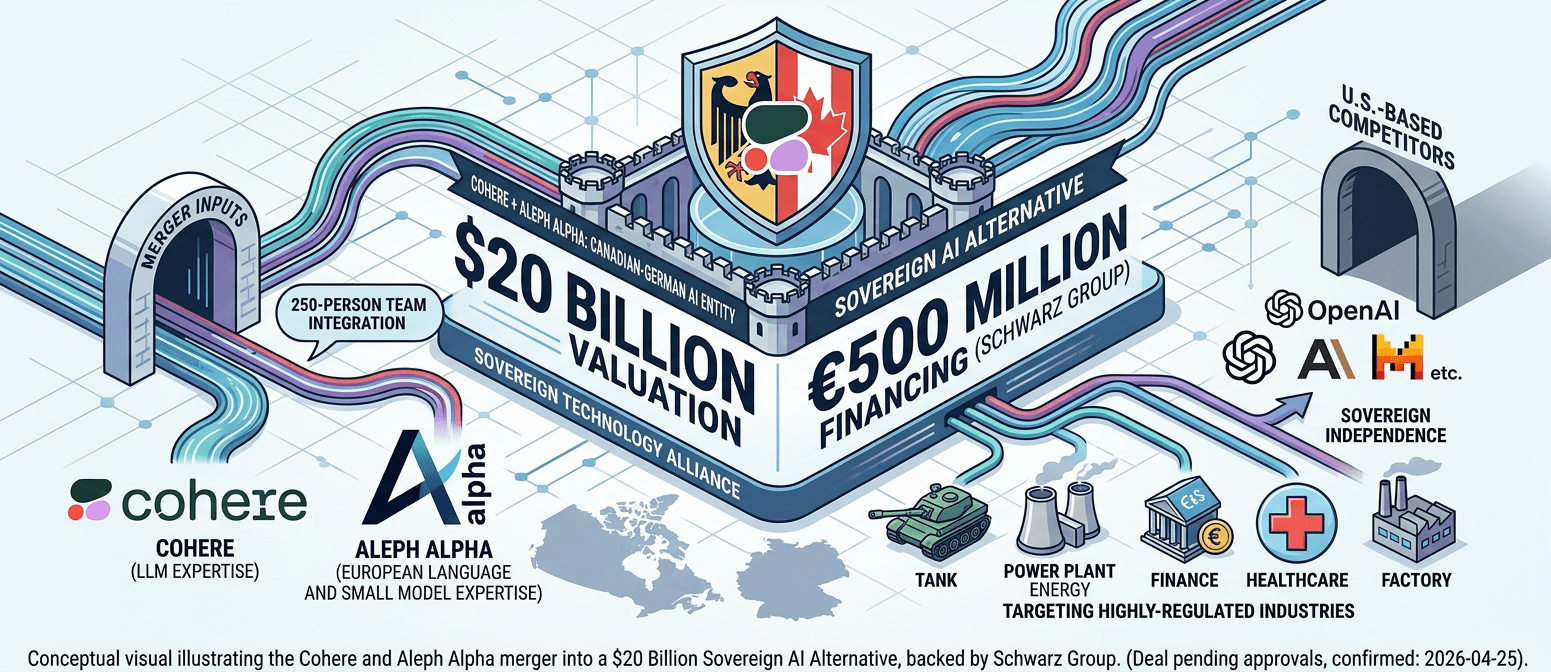
Cohere merged with Aleph Alpha in a $600 million deal backed by Schwarz Group’s €500 million structured financing to form a sovereign AI alternative. The new Canadian-German entity will be led by Cohere, pending approval from Canadian and German authorities and shareholders, with a Series E valuation anchored at ~$20 billion. Cohere reported $240 million in 2025 annual recurring revenue, while Aleph Alpha previously generated little revenue and significant losses, per Dealroom and CNBC, and Schwarz Group will use STACKIT sovereign cloud with the new entity.

Aidan Gomez, Cohere CEO, confirmed the merger terms including Cohere leading the new Canadian-German entity incorporating Aleph Alpha’s 250-person team and PhariaAI suite on April 25, 2026. TechCrunch reported on 2026-04-26. The deal requires approval from Canadian and German authorities and shareholders, with Q2 2026 as the announcement period, no public rollout timeline stated, Schwarz Group’s €500 million financing acts as lead investment in Cohere’s Series E round anchored at ~$20 billion per Handelsblatt, Schwarz Group will use STACKIT sovereign cloud service from its Schwarz Digits IT division, and the new entity targets defense, energy, finance, healthcare, manufacturing, telecommunications and public sector clients.

Aleph Alpha’s 250-Person Team

Aleph Alpha is a Germany-based LLM maker with a 250-person team focused on small language models, European languages and tokenizers, developed the PhariaAI suite for European enterprises and public institutions, and was backed by Schwarz Group as a main shareholder. Aleph Alpha previously pivoted to AI support in September 2024, saw co-founder and CEO Jonas Andrulis depart, generated little revenue and significant losses per Dealroom, and Cohere was last valued at $6.8 billion in August 2025 after raising funding. Cohere CEO Aidan Gomez said, “Their focus on small language models, European languages and tokenizers is a really complementary one to our own, which is more of a general focus on large language models.” The new entity will target highly-regulated industries including defense, energy, finance, healthcare, manufacturing, telecommunications and the public sector, and benefit from the Canada-Germany Sovereign Technology Alliance.

OpenAI, Anthropic Face Sovereign Rival

Benefited companies include Schwarz Group, parent company of Lidl, which will use STACKIT sovereign cloud service from its Schwarz Digits IT division with the new entity, Cohere, which leads the merged Canadian-German company, and Aleph Alpha, which brings European language and small model expertise. Threatened companies include OpenAI, Anthropic, Mistral AI, xAI and Cursor, as the new entity offers a sovereign alternative to U.S.-based AI providers for highly-regulated industries including defense, energy, finance, healthcare, manufacturing, telecommunications and the public sector. The Canada-Germany Sovereign Technology Alliance backs the deal, targeting enterprises with privacy and independence requirements that U.S. providers may not meet, as Cohere and Aleph Alpha previously lagged behind OpenAI globally.

Cohere Targets Regulated Industries

Cohere plans to complete the merger with Aleph Alpha pending Canadian and German regulatory and shareholder approval, incorporating Aleph Alpha’s 250-person team, PhariaAI suite and European language tokenizer expertise, with Schwarz Group as lead investor. Cohere plans to target highly-regulated industries including defense, energy, finance, healthcare, manufacturing, telecommunications and the public sector as a sovereign alternative to U.S. AI providers, backed by the Canada-Germany Sovereign Technology Alliance launched in February 2026. Cohere plans to operate as a Canadian-German company, with an IPO still under consideration per previous TechCrunch reports, and integrate Schwarz Group’s STACKIT sovereign cloud from the Schwarz Digits IT division.

Cohere faces required regulatory approval from Canadian and German authorities and shareholders, with uncertainty over whether European organizations view the Canadian-German entity as sufficiently sovereign for their privacy and independence requirements. Cohere will become a Canadian-German company pending approvals, with an IPO still under consideration after its $6.8 billion August 2025 valuation and $240 million 2025 annual recurring revenue, targeting regulated industries. The merged entity will leverage Aleph Alpha’s European language expertise and Cohere’s large language models to serve sovereign clients.

More

Agentic AI Top 2026 Threat: 48% Cite Anthropic’s Mythos

Anthropic privately warned U.S. officials that its unreleased Mythos AI model can autonomously penetrate corporate, government and municipal systems with unprecedented sophistication, Axios reported. The private warnings highlight the model’s potential to dramatically lower the barrier for sophisticated cyber operations. Top AI and government officials were briefed that Anthropic and other tech giants are preparing models that are ‘scary good at hacking sophisticated systems at scale.’ This follows Anthropic’s disclosure of the first documented cyberattack largely executed by AI, where a Chinese state-sponsored group used agents to autonomously hack roughly 30 global targets, with the AI handling 80-90% of tactical operations independently. The warnings underscore the threat of a likely surge in large-scale cyberattacks this year. Axios reported on March 29, 2026, that Anthropic’s unreleased Mythos model is currently far ahead of any other AI model in cyber capabilities. An unpublished Anthropic blog post obtained by Fortune describes Mythos as capable of exploiting vulnerabilities in ways that far outpace defenders. The model can autonomously hack systems with agents that think, act, reason and improvise without rest, allowing bad actors to scale attacks simply by adding more compute. A single individual could now run campaigns once requiring entire teams, democratizing cybercrime. These capabilities position Mythos as a significant advancement in offensive AI. Anthropic has not disclosed the model’s pricing or availability, per Axios. According to Axios, CEO Jim VandeHei said his tech team considers this ‘the biggest threat to Axios right now.’ This assessment highlights the immediate risk from agentic AI capabilities like those in Mythos. The ability to operate without rest enables round-the-clock attacks, while reasoning and improvisation allow real-time adaptation to defenses. The scaling via compute means resource-constrained actors can launch large-scale operations, lowering the entry barrier for cybercrime. The combination of powerful new models and widespread unsupervised experimentation creates a ‘perfect storm for cybercrime,’ as Axios noted. These factors require companies to implement strict controls on AI agent usage and create isolated testing environments. The persistent nature of these attacks means that even automated defenses may struggle to keep pace, necessitating continuous monitoring and adaptive response mechanisms. per Axios, no companies are identified as beneficiaries of Mythos’s capabilities, while headwinds include the rise of ‘shadow AI,’ where employees connect home-experimented AI agents to corporate systems, creating new attack vectors. Axios also reports that a Dark Reading poll found 48% of cybersecurity professionals rank agentic AI as the top attack vector for 2026, above deepfakes. This consensus indicates a shift in threat priorities, with agentic AI now considered more dangerous than traditional vectors. The expansion of shadow AI exponentially increases the attack surface, as home networks lack enterprise security. Companies are therefore urged to educate employees on these dangers and establish secure testing environments to mitigate the escalating risks. OpenAI is among the competitors developing advanced AI models with significant cyber capabilities, Axios reported. While specific product details are scarce, the briefing indicated these models are ‘scary good at hacking sophisticated systems at scale,’ matching the threat level of Mythos. This competitive dynamic indicates that multiple major AI players are pushing the boundaries of offensive AI. The involvement of numerous firms increases the likelihood that such capabilities will become widely available, potentially lowering the barrier for malicious actors. Companies should therefore monitor developments across the AI sector, not just from Anthropic, to understand the evolving threat landscape. The proliferation of these models could lead to an arms race in both offensive and defensive AI technologies, prolonging the cybersecurity challenge. Axios reported that Anthropic has not disclosed a specific roadmap for Mythos. The unpublished blog post warned that Mythos presages an upcoming wave of models that can exploit vulnerabilities even faster, indicating continued development in offensive AI. Without public release dates, companies must prepare for more advanced models to emerge in the near future, extending the cybersecurity challenge. The lack of transparency around release timelines complicates defensive planning, as organizations cannot anticipate when to expect such capabilities in the wild. This uncertainty underscores the need for proactive measures and continuous adaptation in cybersecurity strategies. As AI research advances, the gap between offensive and defensive capabilities may widen, requiring sustained investment in security innovation.

Featured Posts